What is the difference between fully laminated LOCA and OCA for tou
Date:2026-06-04
The "water glue" and "sheet glue" (usually referring to OCA optical glue) in full lamination of touch screens, although both aim to eliminate air layers between screens and improve display effects, have essential differences in material form, applicable scenarios, and processes.
Simply put, you can understand them as "liquid glue" and "solid tape".
The following chart can help you visually see the differences between them in various key indicators:
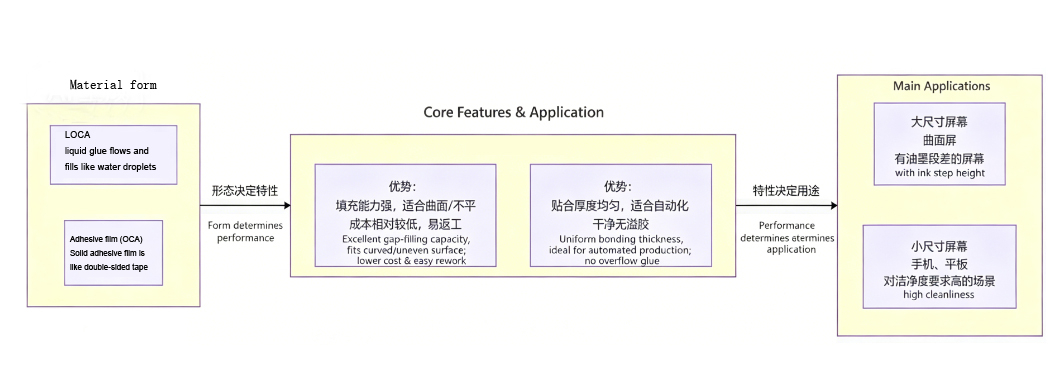
Water glue: liquid filling, flexible and efficient
The scientific name of water-based adhesive is LOCA (Liquid Optical Transparent Adhesive), which is a type of liquid adhesive that resembles water.
Core advantages:
Strong adaptability: As a liquid, it can perfectly fill the small bumps, curved edges, or gaps caused by printing ink on the screen surface, with almost no bubbles.
Cost and repair: The material cost is relatively low, and it is relatively easy to separate and reattach in case of bonding errors, reducing the scrap rate.
Main limitations:
Process control: Accurate control of dispensing volume and leveling is required, and the curing process also takes time, with the risk of glue overflow.
Appearance risk: In rare cases, yellowing may occur if the formula is poor.
Suitable for scenarios: large-sized screens (such as televisions, car infotainment systems), curved screens, and screens with complex structures.
Adhesive: Solid film, precise and stable
The scientific name of sheet adhesive is OCA (Solid State Optical Transparent Adhesive), which is a double-sided tape without a substrate and appears as a transparent film.
Core advantages:
Stable effect: The thickness is very uniform, there is no glue overflow problem after bonding, the optical performance is stable, and it is clean and tidy.
High efficiency: Suitable for large-scale automated bonding production lines, with high production efficiency.
Main limitations:
Adaptability and cost: Not suitable for curved or uneven surfaces, it is easy to generate bubbles at the ink steps. In addition, each screen usually requires customized mold making, which incurs high material costs.
Suitable scenarios: Small and medium-sized screens, such as mobile phones, tablets, smart wearables, etc.
Summary: How to choose?
There is no absolute superiority or inferiority between these two adhesives, it depends more on specific application requirements:
If you pursue ultimate display accuracy and automated production efficiency, and your products are small-sized flat screens such as smartphones and tablets, sheet glue is the mainstream choice.
If your screen size is large, or if you have a curved or 2.5D glass design, or if you want to better control costs and reduce repair risks, then water-based glue would be a more suitable solution.