AUO G173HW series LCD module feeding inspection A standard
Date:2026-04-08
A Preliminary Analysis of the A Standard for Incoming Inspection of AUO G173HW Series LCD Modules
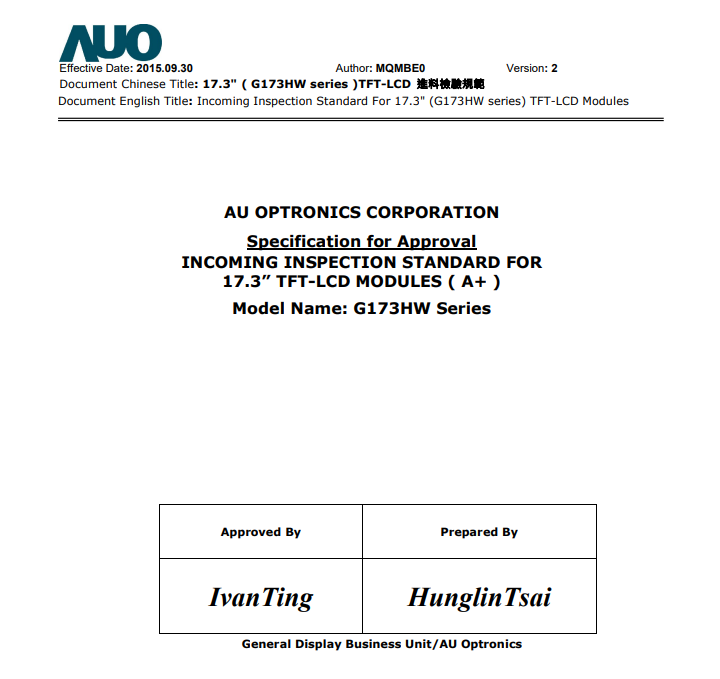
Analysis of the Incoming Inspection Standards for AUO G173HW Series LCD Modules
In the field of modern display applications, the quality of TFT-LCD modules directly affects the performance and user experience of end products. As a leading global supplier of display panels, AU Optronics (AUO) has established detailed incoming inspection standards for its 17.3-inch G173HW series LCD modules. This standard not only reflects the manufacturer's strict control over product quality, but also provides customers with a unified and operable acceptance basis. This article is based on the latest specifications of the series (revised in 2015), and summarizes and interprets its core content.
1.Scope of Inspection and Responsibility Allocation
This specification clearly states that customers are required to complete the incoming inspection within 20 calendar days from the date of delivery, at their own expense. The inspection results shall be recorded in writing and promptly notified to the seller. If unacceptable defects are found in the entire batch of modules during the inspection period, the customer shall notify the seller in writing within three working days after the end of the inspection period; Failure to notify within the deadline shall be deemed as acceptance of the batch of products by default. This clause emphasizes the timeliness and responsibility boundaries of inspection, which is beneficial for both buyers and sellers to efficiently handle quality issues.
2.Sampling method: based on MIL-STD-105E standard
The specification adopts the US military standard MIL-STD-105E as the sampling basis, and the specific parameters are as follows:
Batch definition: The quantity of each model and each shipment batch is one batch.
Sampling type: normal inspection, one-time sampling.
Inspection level: Level II.
Acceptable Quality Level (AQL): 1.0% for major defects and 2.5% for minor defects.
In addition, the standard provides a sample code table (Table 14-1), which determines the corresponding sample size based on batch size and provides a judgment flowchart for inspectors to quickly execute.
3. Testing environment and instrument requirements
In order to ensure the repeatability and comparability of inspection results, strict regulations have been made for the inspection environment in the standard:
Temperature: 20-25 ℃
Humidity: 65% ± 5% RH
Illumination: 300-700 lux under fluorescent lamp (standard 500 lux)
Observation distance: about 35 ± 5 cm from the surface of the module, with the line of sight perpendicular to the screen
Observation method: The protective film of the polarizer needs to be removed and visually judged by the human eye
The instruments used include signal generators (such as LD-2000), AU dedicated video boards, and luminance colorimeters (such as Topcon BM-7). These conditions ensure the standardization and objectivity of the inspection.
4.Defect classification: major defects and minor defects
The standard categorizes defects into two main types:
Main defects: Defects that may cause product failure or significantly reduce its intended use.
Minor defects: Deviations that have little impact on the expected use of the product or have little impact on effective use.
This classification directly corresponds to the different tolerances of AQL and guides inspectors to make reasonable judgments on the severity of defects.
5. Electrical Inspection Specification: Point Defects and Line Defects
Electrical performance is the core quality indicator of LCD modules. The G173HW series has very strict requirements for pixel defects (point defects):
Highlight: No highlights allowed (0).
Dark spot: A maximum of 3 dark spots are allowed.
Total defects: no more than 3.
Continuous defect: Two consecutive bright spots (vertical, horizontal, or oblique) are not allowed; Three or more consecutive bright spots are not allowed; Two consecutive dark spots allow for one pair; Three or more consecutive dark spots are not allowed; Adjacent bright and dark spots are also not allowed.
Highlight spacing: It is not allowed for two bright spots to be too close to each other; The distance between dark spots must be ≥ 15 mm; the distance between bright spots and dark spots is not allowed.
Mura (non-uniformity): Determine using a 6% ND filter.
It is particularly noteworthy that the standard has clearly defined "sub-pixel": a defect area greater than or equal to 1/2 of the sub-pixel area is counted as a point defect; Smaller bright spots are considered as "small bright spots", with a maximum of 10 allowed, and a 5% ND filter (30 cm distance) is required to distinguish between bright spots and small bright spots.
The inspection graphics cover four standard patterns: black, red, green, and blue, which are used to detect bright or dark spots respectively. This helps to comprehensively evaluate the pixel performance under different colors.
6. Appearance Inspection Specification
Appearance defects include particles, scratches, bubbles, dirt in the active area, as well as frame deformation, abnormal labels, loose screws, connector appearance, etc. The standard provides the allowable quantities corresponding to different size ranges in the form of a table:
Circular particles/foreign objects: diameter D<0.4 mm can be ignored; 0.4 ≤ D < 0.6 mm, a maximum of 10 are allowed; D ≥ 0.6 mm is not allowed.
Linear scratches/dirt: Width W ≤ 0.05 mm and length L ≤ 2 mm can be ignored; 0.05<W ≤ 0.07 and 20.07 and L>5 mm are not allowed.
Bubbles: also judged by diameter and quantity.
Border gap: The gap between the front and rear borders is allowed to be ≤ 0.8 mm.
Tags: No tags, content errors, positional offsets, wrinkles, or overlaps are allowed; If the stain does not exceed 30 mm x 20 mm and can still read words and scan barcodes, it is considered acceptable.
In addition, the standard also provides a formula for determining linear defects (considered linear defects when L ≥ 2W), as well as a method for calculating the average diameter of foreign objects (D=1/2 (W+L)). Wipable foreign objects (such as fingerprints and floating dust) are not considered defects; Defects in the black matrix region (within 0.3 mm outside the active area) are also not considered.
7. Inspection and determination, as well as handling of non conformities
According to the normal inspection sampling plan of MIL-STD-105E, if the number of defects in the sample is less than or equal to the allowable number, the batch is judged to be qualified; If the number of defects is greater than the number of rejections, the batch shall be deemed rejected. The customer shall notify the seller in writing of the rejection result. This process ensures the clarity and traceability of the judgment results.
8. Precautions for use: Key points to extend the lifespan of the module
The specification finally lists 19 usage precautions, covering mechanical stress, heat dissipation, dust prevention, power timing, electrostatic protection, backlight high-voltage safety, storage environment, etc. Special reminder to avoid displaying static images for a long time (except for white) to prevent image sticking; Avoid using in environments with drastic temperature changes to prevent condensation from damaging the polarizing film; Do not disassemble the module by yourself; Pay attention to the risk of high-voltage electric shock, etc. These suggestions have important reference value for both machine manufacturers and end users.
Conclusion
The feed inspection standard for the AUO G173HW series 17.3-inch LCD module is a rigorous, comprehensive, and operable technical document. It not only clarifies the quantitative judgment criteria for electrical and appearance defects, but also standardizes the inspection environment, sampling methods, and usage precautions. For the purchaser, strictly following this standard for incoming inspection helps to control the display quality from the source; For industry practitioners, this standard also provides a good example for understanding the quality requirements of high-end LCD modules. With the continuous advancement of display technology, such standardized documents will continue to play a key role in supply chain quality assurance.
AUO 17.3-inch LCD module:https://www.auo-lcd.com/products/auo-lcd-screen/17_3inch/