AUO's End of Life (EOL) Process for Industrial Markets
Date:2026-03-24
AUO's End of Life (EOL) Process for Industrial Markets and the Customer Value Behind It
Be prepared for the future: Interpreting the discontinuation process of AU Optronics' "G Model" to safeguard industrial customers
In the field of industrial displays, product lifecycle management is a crucial discipline. Unlike consumer electronics that pursue rapid iteration, industrial equipment often requires stable supply cycles of 5 to 10 years or even longer. Therefore, when a product reaches the end of life (EOL), how to smoothly transition directly affects the production safety and commercial interests of downstream customers.
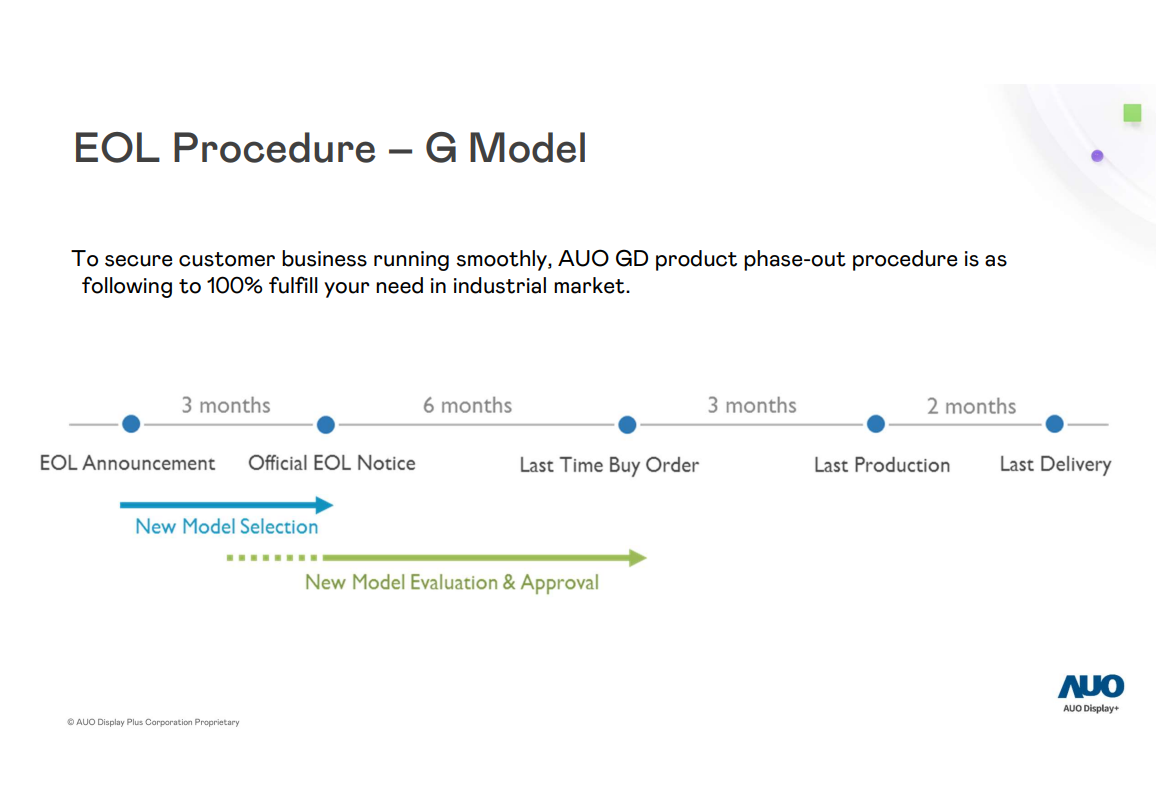
As a leading global display panel company, AU Optronics (AUO) is well versed in this field. From its discontinuation process for the "G Model" series, it can be seen that a rigorous, transparent, and buffer rich EOL mechanism is not only a farewell to the product, but also a continuation of customer commitments.
From announcement to conclusion: a precise "soft landing" plan down to the month
According to AU's process design, the discontinuation of a G Model product is not a sudden suspension, but is divided into four key stages, with a total span of 14 months, leaving enough time for customers to react and switch.
Phase 1: EOL Declaration and Evaluation (Months 1-3)
The starting point of the process is the official release of EOL notifications. This is not a simple 'suspension notice', but a signal to activate. At this stage, AU has simultaneously opened channels for "new model selection" and "new model evaluation and approval". This means that while announcing the imminent delisting of old products, the technical team has intervened to assist customers in finding the best alternative solutions, ensuring compatibility between new and old products in terms of electrical, mechanical, and optical characteristics.
Phase 2: Final procurement window period (months 4-9)
During the period of 3 to 6 months after the EOL notification is issued, customers will receive a window for the Last Time Buy Order. This is a critical time point. Customers can submit the final batch of purchase orders based on their actual needs for future maintenance and production. This six-month buffer period provides customers with sufficient financial budget and production scheduling space, avoiding inventory backlog caused by panic stocking and preventing production line shutdowns due to supply disruptions.
Phase 3: Final production (months 10-12)
After the final purchase order is issued, AU will use the next three months for final production. This period is mainly used to digest orders and ensure that all customers' needs during the transition period are met. At this stage, the production line will carry out the final capacity allocation and concentrate resources to complete this batch of "final work".
Phase Four: Final Delivery (Months 13-14)
After production is completed, the last two months are the delivery period. Thus, the entire EOL process has officially come to an end. The 14 month cycle from notification to final delivery is sufficient for industrial customers to complete all the work of product redesign, certification testing, and inventory switching.
The 'reassurance pill' for the industrial market
The core reason why AU has designed such a detailed process is the particularity of the industrial market.
Industrial equipment (such as medical instruments, industrial control equipment, and vehicle displays) often have long certification cycles and high replacement costs. If the panel suddenly runs out of supply, customers may need to spend a high cost to modify the mold, redo safety certification, or even cause the entire project to fail.
Through this "3+6+3+2" tiered process, AU achieved three values:
Risk avoidance: Clear timeframes enable customers to plan accurately, eliminating the risk of supply chain disruptions.
Technical integration: Providing alternative solutions while announcing production stoppage reduces the research and development costs for customers to search for suppliers again.
Inventory optimization: A final procurement window of up to 6 months allows customers to stock up on maintenance spare parts without excessive stockpiling due to information opacity.
Conclusion
In the business world, product replacement is the norm, but how to deal with "delisted" products often reflects a company's responsibility and strength more than how to promote "new products".
The EOL process of the AU Optronics G Model may seem like a cold execution schedule, but it is actually a warm commercial commitment to customers. It not only demonstrates AU's maturity in supply chain management, but also proves its determination to deeply cultivate the industrial market and achieve long-term win-win results with customers. For customers who choose AU, this mechanism is undoubtedly a "reassurance pill" that allows them to face market fluctuations more calmly.
AU Optronics (AUO):https://www.auo-lcd.com/products/auo-lcd-screen