AU's 4.3-inch technology layout strategy for 2026
Date:2026-03-24
AU's technological layout and market strategy for 2026 on the classic 4.3-inch size
AUO's 4.3-inch 'Way of Refinement': Technological Upgrade for Small and Medium Sized Display from Product Specifications.
In the display panel industry, large-sized products often receive more attention, but in professional application fields such as industrial, automotive, medical, and drone controllers, small and medium-sized sizes like 4.3 inches play an irreplaceable role. They have extremely strict requirements for reliability, viewing angle, brightness, and lifespan, and are also an important touchstone for panel manufacturers' technical strength.
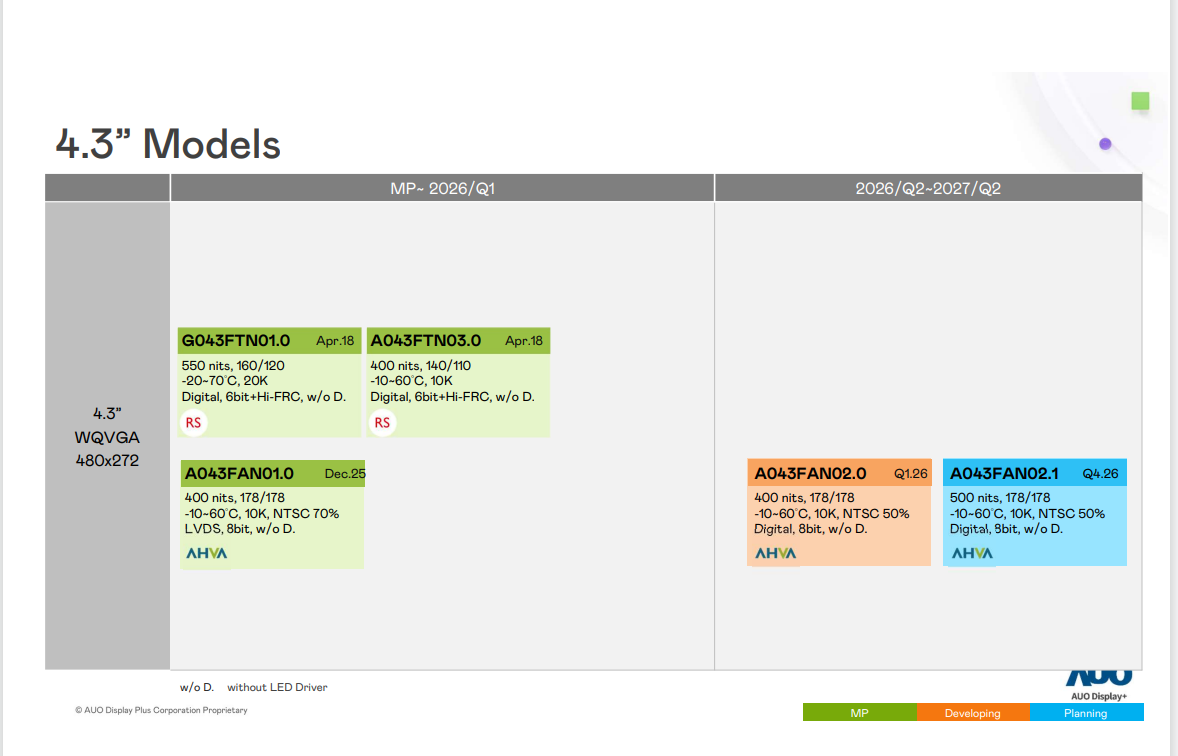
According to the product roadmap shown in the picture, we can see a series of layouts of AUO in the 4.3-inch specification, from which we can glimpse the evolution of small and medium-sized display technology.
Product Matrix: Parallel Two Technological Pathways
From the model perspective, 4.3-inch products are mainly divided into two series:
1. G series and A series (early products)
G043FTN01.0 (released in April 2018): 550 nits brightness, 160 °/120 ° viewing angle, operating temperature -20~70 ° C, lifespan of 20K hours;
A043FTN03.0 (released in April 2018): 400 nits brightness, 140 °/110 ° viewing angle, operating temperature -10~60 ° C, lifespan of 10K hours;
These two products represent the early TN (Twisted Nematic) technology route, with advantages such as high brightness and fast response, but relatively limited viewing angles.
2. A-series AHVA technology (new products in 2025-2026)
A043FAN01.0 (released in December 2025): 400 nits brightness, 178 °/178 ° wide viewing angle, AHVA technology;
A043FAN02.0 (released in Q1 2026): 400 nits brightness, 178 °/178 ° wide viewing angle, AHVA technology;
A043FAN02.1 (released in Q4 2026): 500 nits brightness, 178 °/178 ° wide viewing angle, AHVA technology;
AHVA (Advanced Hyper Viewing Angle) is a wide viewing angle technology developed by crowdsourcing, similar to IPS, which significantly outperforms TN in terms of viewing angle and color performance.
Three key dimensions of technological upgrading
1. Perspective: The Crossing from TN to AHVA
The perspective of early products (160 °/120 ° or 140 °/110 °) has limitations in industrial applications, especially the narrow vertical perspective, which limits the flexibility of installation and viewing. The new generation AHVA products have raised the viewing angle to 178 °/178 °, almost reaching the full viewing angle level, greatly improving the applicable scenarios.
2. Brightness: Moving from 400 nits to 500 nits
Brightness is a key indicator in outdoor or high ambient light scenes. The A043FAN02.1, which will be mass-produced in Q4 2026, will increase its brightness to 500 nits, a 25% increase compared to the 400 nits of earlier products, while maintaining AHVA's wide viewing angle advantage.
3. Life and reliability: differentiated market positioning
G043FTN01.0 has a lifespan of 20K hours and a wide temperature range of -20~70 ° C, which is obviously aimed at industrial or vehicle scenarios with higher reliability requirements
The AHVA series has a lifespan of 10K hours and a working temperature of -10~60 ° C. It is more suitable for consumer or light industrial applications
This differentiated layout reflects the precise coverage of different application scenarios by manufacturers.
Interface and Color: Standardization and Differentiation Coexist
From the interface perspective, early products mostly used Digital interfaces (6bit+Hi FRC), while the new generation AHVA products introduced LVDS interfaces (8-bit), which improved data transmission speed and color depth.
In terms of color gamut:
A043FAN01.0 supports NTSC 70%, with richer color performance;
A043FAN02.0/02.1 is NTSC 50%, positioned more towards cost sensitive applications;
It is worth noting that all models are labeled with "w/o D." (without LED Driver), which means that the LED driver circuit needs to be configured by the customer themselves. This is a common design method for industrial/commercial display modules, providing greater flexibility for system integrators.
Inspiration from Timeline: Mass Production Nodes in 2026
From the timeline of product planning:
December 2025: A043FAN01.0 mass production
2026 Q1: A043FAN02.0 mass production
2026 Q4: A043FAN02.1 mass production
This indicates that 2026 will be a crucial year for AHVA technology to fully expand in the 4.3-inch market. As the brightness increases to 500 nits and the viewing angle reaches the full viewing angle level, the performance threshold for small and medium-sized display products will be redefined.
The Path to Specialization for Small and Medium Sizes
The continuous iteration of the classic size of 4.3 inches reflects an important trend in the display industry: while pursuing ultimate image quality in large sizes, small and medium-sized sizes are moving towards deeper specialization. Whether it is wide temperature range, high brightness, wide viewing angle, or the balance between lifespan and cost, panel manufacturers are finely polishing according to the needs of segmented markets.
For system integrators in the fields of drone controllers, industrial handheld devices, medical monitors, and in vehicle displays, understanding the technical roadmap and timeline behind these product specifications will help to more accurately plan and layout the supply chain.
G043FTN01.0:https://www.auo-lcd.com/products/auo-lcd-screen/4_3inch/g043ftn01_0.html
AUO 4.3-inch LCD screen:https://www.auo-lcd.com/products/auo-lcd-screen/4_3inch/