One-stop touch solution: reshaping display and manufacturing processes
Date:2026-04-20
One-stop touch solution: Simplifying and enhancing complex manufacturing processes
Today, with the continuous upgrading of display technology and human-computer interaction, touch panels have become a core component of various terminal devices. However, from display modules to touch integration, and ultimately to system applications, traditional manufacturing processes often involve multiple supply chain links, which not only incurs high communication costs but also easily affects product quality and delivery efficiency. Against this backdrop, "one-stop service" is gradually becoming an important direction for industry development.
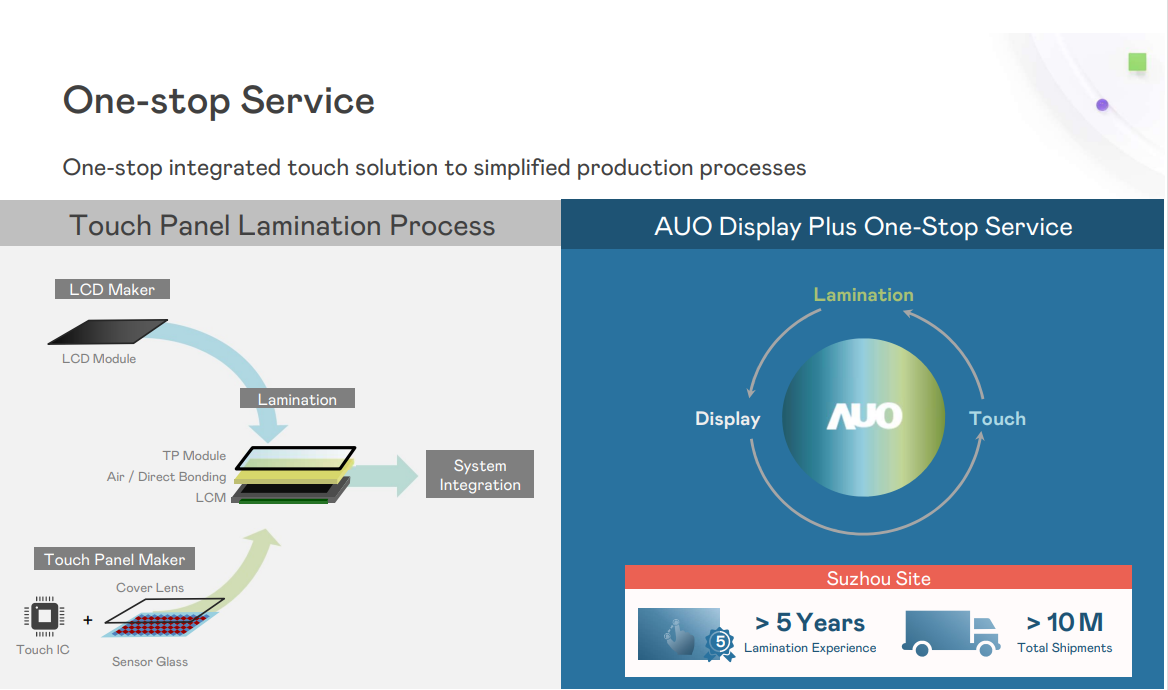
From Fragmentation to Integration: Transforming the Touch Control Manufacturing Process
The production process of traditional touch panels typically involves multiple stages. Initially, LCD manufacturers provide the display module (LCD Module). Subsequently, the touch panel (TP Module) is combined with the display module through a lamination process to form a complete liquid crystal module (LCM). Simultaneously, touch panel manufacturers also need to prepare key components including cover glass (Cover Lens), sensor glass (Sensor Glass), and touch IC. Finally, these components proceed to the system integration stage (System Integration) to complete the assembly of the end product.
Although this segmented process brings clear specialization and division of labor, it also leads to issues such as complex information transmission, longer cycles, and increased difficulty in quality control.
One-stop service: the key to enhancing efficiency and quality
In contrast, the one-stop touch solution integrates three core aspects: "display, touch, and lamination", enabling the completion of originally separate processes on a single platform. This model not only simplifies the production process but also significantly enhances overall efficiency.
In the integrated service system, a closed-loop collaboration is formed among various links, where everything from design to manufacturing and integration is carried out under a unified standard, effectively reducing communication costs and technical errors. Meanwhile, centralized production also ensures stricter quality control and higher product consistency.
Bonding process: The core of connection performance and experience
In the entire process, bonding technology plays a crucial role. Whether it is Air Bonding or Direct Bonding, it directly affects the display effect and touch sensitivity. High-quality bonding can not only enhance the light transmittance and clarity of the screen, but also reduce reflection, strengthen structural integrity, and ultimately improve the user experience.
One-stop service providers typically possess mature bonding experience and technical expertise, enabling them to select the optimal process plan based on different application scenarios and ensure the best balance between product performance and reliability.
Experience and scale: the guarantee of stable delivery
A mature one-stop solution is not only reflected in its ability to integrate technologies, but also in its rich experience in mass production and stable delivery capabilities. With a production base that boasts years of lamination experience, it can better cater to different customer needs and achieve flexible switching from small batch customization to large-scale shipments. At the same time, the capability to ship large quantities also signifies higher supply chain stability and more competitive cost control.
Future-oriented manufacturing model
With the continuous development of smart devices, in-vehicle displays, and industrial control, the market's demands for touch display solutions will become more diversified and high-standard. One-stop service is not only an efficiency tool, but also a future-oriented manufacturing model.
By deeply integrating resources and technology, this model is redefining the operational approach of the touch industry chain, allowing enterprises to focus more on product innovation and user experience, while entrusting the complex manufacturing processes to professional platforms for efficient completion.
In an era where efficiency and quality are equally valued, a one-stop touch solution will undoubtedly become a significant force driving the continuous progress of the industry.