The evolutionary journey of AUO's touch display
Date:2026-04-17
The evolutionary journey of AUO's touch display: from customized design to full-chain capabilities of integrated integration
In today's era of rapid iteration in smart devices, touch display has evolved beyond being merely an "input interface" to become a core component of product experience. From industrial equipment to consumer electronics, and further to automotive and medical fields, customers' demands for touch solutions are becoming increasingly diversified and refined. This has propelled the touch industry from a single product supply to an era of comprehensive solutions featuring "customization + integration".
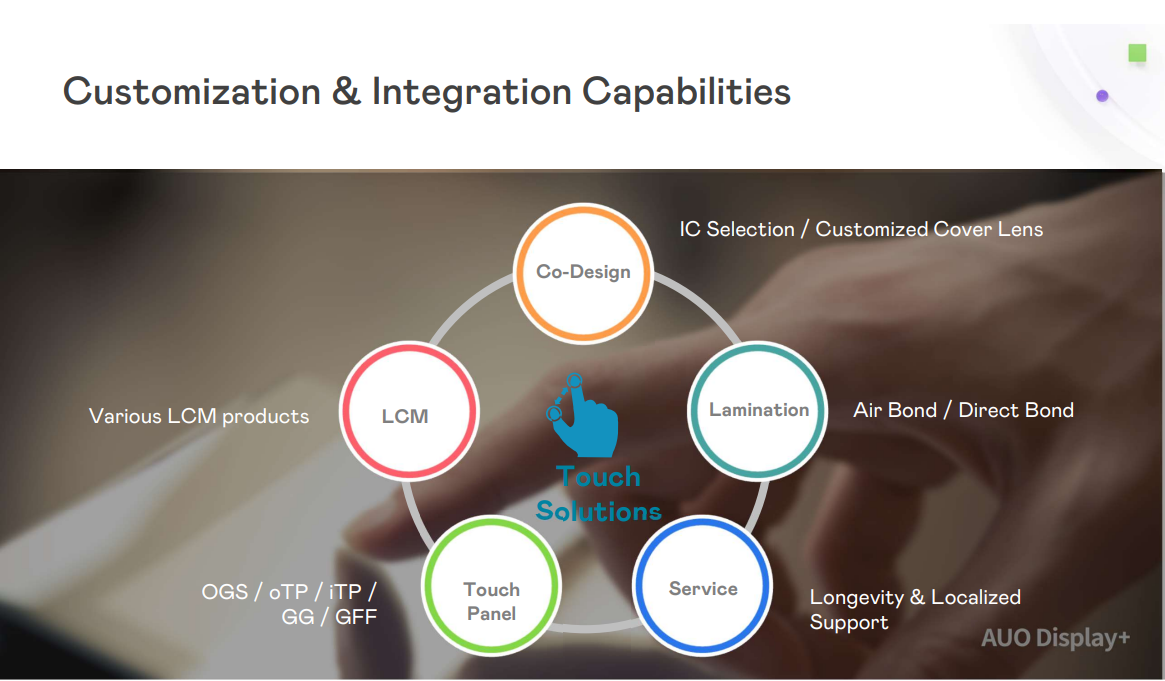
As can be seen from the figure, a complete touch solution from AUO revolves around five core capabilities: Co-Design, Lamination, Service, Touch Panel, and LCM (Liquid Crystal Module), forming a closed-loop ecosystem.
First and foremost is Co-Design. In the early stages of product development, touch panel manufacturers are no longer mere executors; they are partners deeply involved in customer design. From IC selection to the customization of cover lenses, everything needs to be optimized according to the application scenario. For instance, outdoor equipment places greater emphasis on resistance to strong light and weatherability, while industrial equipment focuses more on anti-interference and glove touch performance. Deep involvement in early-stage design directly determines the stability of subsequent products and the user experience.
Next is the lamination technology, which is a crucial aspect affecting display quality and structural reliability. The Air Bond (air lamination) and Direct Bond (full lamination) mentioned in the figure are suitable for different cost and performance requirements. Full lamination technology can effectively reduce reflection, enhance display clarity, and strengthen structural integrity, while air lamination offers advantages in cost control. Striking a balance between the two is a significant demonstration of integration capability.
In terms of core components, the Touch Panel and LCM (Liquid Crystal Module) constitute the hardware foundation. The touch panel supports multiple technical paths, such as OGS, oTP, iTP, GG, GFF, etc., with different solutions focusing on thickness, sensitivity, and cost. The LCM determines the display quality, including brightness, color, and power consumption performance. Efficient integration of touch and display is the key to achieving thinness and high performance.
Meanwhile, service capability (Service) cannot be overlooked. The figure emphasizes "Longevity & Localized Support", which is particularly important for industrial and automotive customers. Compared to consumer electronics, professional equipment has a longer lifecycle. Stable supply and responsive local services can significantly reduce customers' operational risks.
It is worth noting that this entire set of capabilities does not exist in isolation, but is systematically integrated around "Touch Solutions". Through modular and platform-based design, manufacturers can flexibly combine different technologies to achieve a smooth transition from standard products to highly customized products.
Overall, the touch industry is shifting from "selling products" to "providing solutions". Whoever can establish efficient collaboration between design, manufacturing, integration, and service will gain an advantage in competition. In the future, with the emergence of more application scenarios, this integrated capability will no longer be a plus, but rather a basic threshold for the industry.
AUO Industrial Touch Screens:https://www.auo-lcd.com/products/auo-lcd-screen/