Conclusion AUO's 4K Ultra HD resolution WCG wide color gamut
Date:2026-04-16
Analysis of AUO's leading display technology: the synergistic effect of 4K Ultra HD, wide color gamut, and high contrast ratio
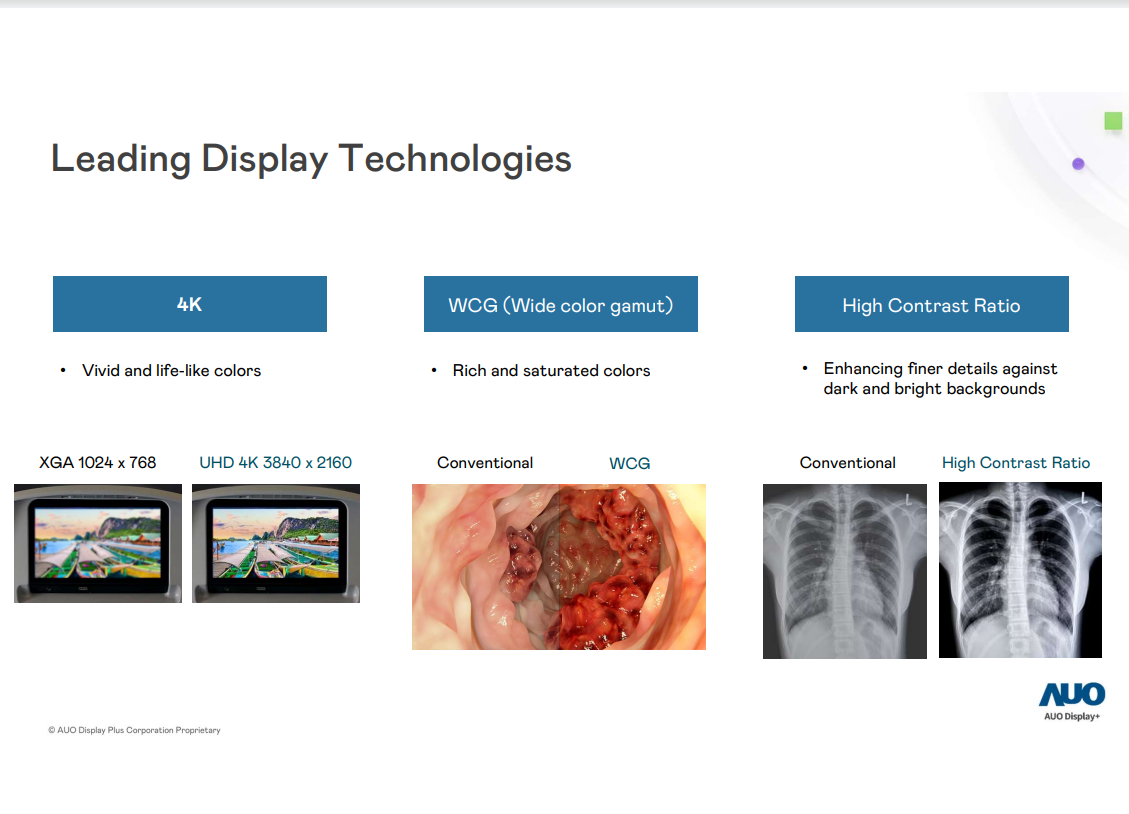
AUO's leading display technology: How 4K, wide color gamut, and high contrast reshape the visual experience
In today's digital era, AUO's display technology is evolving at an unprecedented pace. From industrial control panels to medical imaging displays, from professional design workstations to high-end commercial displays, users' demands for image quality are becoming increasingly stringent. Below, we will explore three leading display technologies - 4K Ultra HD resolution, WCG wide color gamut, and high contrast - and how they collectively contribute to a more realistic and immersive visual experience.
1. AUO LCD screen 4K Ultra HD resolution: every detail is clearly visible
Resolution is the foundation that determines the clarity of an image. Display technology has undergone a qualitative leap, evolving from the traditional XGA (1024×768) to the mainstream FHD (1920×1080), and now to the UHD 4K (3840×2160).
Core advantages of 4K:
Four times the pixel density of FHD: With over 8 million pixels, 4K resolution boasts four times the pixel density of FHD, delivering incredibly rich image details;
Sharper text and graphics: At high resolution, text edges are smoother and graphic lines are clearer;
Larger information display space: More content can be displayed on the same screen simultaneously, enhancing work efficiency;
Immersive visual experience: With a large-sized screen, 4K brings cinema-level immersion;
For application scenarios that require precise presentation of details, such as medical imaging diagnosis, geographic information systems (GIS), professional design, and security surveillance, 4K resolution has become an indispensable basic configuration.
"Vivid and life-like colors" - 4K not only brings clear details, but also provides a platform for vivid and lifelike colors.
II. AUO LCD WCG Wide Color Gamut: Bringing Colors Back to Reality
Resolution determines the "sharpness" of an image, while color gamut determines the "realism" of an image. WCG (Wide Color Gamut) technology is capable of displaying richer and more saturated colors than traditional displays.
Wide color gamut vs. traditional color gamut:
Comparative dimension | Traditional color gamut | WCG Wide Color Gamut |
Color richness | Limited color range | Significantly expanded color space |
Color saturation | relatively bland | Rich and saturated |
Color accuracy | Meeting basic needs | Accurately reproduce the colors of the real world |
Typical Applications | Daily office work, basic display | Professional design, medical imaging, high-end audio and video |
Core advantages of wide color gamut:
More authentic color reproduction: capable of displaying natural colors that are closer to human visual perception
More saturated visual effects: redder reds, greener greens, and deeper blues
Smoother color transitions: Combine with high color depth to avoid color discontinuity
For fields that require extremely high color accuracy, such as professional photography post-production, video color grading, medical image diagnosis, and high-end graphic design, WCG wide color gamut technology is a standard feature for professional-grade display devices.
"Rich and saturated colors" - WCG wide color gamut technology brings vitality to every frame of the picture.
III. AUO LCD screen with high contrast: between light and dark, every detail is fully displayed
Contrast is a core indicator for measuring the difference between light and dark on a display. High contrast technology can present finer details in both dark and bright backgrounds, making the image's layering more distinct.
High contrast vs. traditional contrast:
Comparative dimension | Comparative dimension | High contrast |
Black performance | Greyish-black | Deep and pure black |
Highlight details | It is prone to overexposure, resulting in loss of details | The details of the bright areas are clearly visible |
Shadow detail | The dark areas are blurred, and the layers are unclear | The details in the dark scenes are fully presented |
Image layering | relatively flat | Strong three-dimensional effect, clear hierarchy |
Core advantages of high contrast:
Deeper black: In dark scenes, the black is purer, enhancing the overall image quality
Brighter white: The details in the highlight areas won't be overexposed
Richer grayscale levels: From the darkest to the brightest, each brightness level has a clear transition
Better HDR performance: High contrast is the foundation for achieving HDR (High Dynamic Range) effects
For application scenarios such as medical imaging (X-ray, CT, MRI), surveillance and security (night vision images), professional video editing, and high-end gaming, high contrast technology ensures the capture of key details even in complex light and dark environments.
"Enhancing finer details against dark and bright backgrounds" - High contrast technology makes the details of both dark and bright areas clearly visible, ensuring that no crucial information is missed.
IV. Trinity: Synergistic Effect of 4K + WCG + High Contrast
Individual features such as 4K resolution, WCG wide color gamut, or high contrast can all enhance picture quality, but the real breakthrough comes from the synergistic effect of the three:
Technology portfolio | Synergistic effect |
4K + WCG | High resolution provides sufficient pixel capacity for a wide color gamut, resulting in smoother color transitions and richer details |
4K + high contrast | High resolution sharpens the details of light and dark, enhances the sense of hierarchy with high contrast, and multiplies the three-dimensional effect of the image |
WCG + high contrast | The wide color gamut provides rich colors, while the high contrast enhances the contrast between light and dark, making the color representation more vivid and powerful |
4K + WCG + high contrast | A complete immersive visual experience: comprehensive enhancement in clarity, color fidelity, and shading depth |
V. Application Scenarios and Selection Recommendations
Different application scenarios have different focuses on display technology:
Application scenarios | Recommended technology combination | Core demand |
Medical imaging diagnosis | 4K + high contrast | Accurately present lesion details with clear shading and layering |
Professional design and video editing | 4K + WCG | High resolution + accurate color reproduction |
Security surveillance | 4K + high contrast | Capture image details, with clear night vision scenes |
High-end commercial display/digital signage | 4K + WCG + high contrast | Attract attention and enhance brand image |
Industrial HMI/control room | high contrast + wide viewing angle | Clearly visible from multiple angles, conveying accurate information |
Conclusion
AUO's 4K Ultra HD resolution, WCG wide color gamut, and high contrast are redefining the standard of "good picture quality". Whether it's the precise identification of lesion details in medical imaging, the stringent requirements for color authenticity in professional design, or the eye-catching first impression in high-end commercial displays, the integration of these three technologies can provide an excellent solution.
With the continuous evolution of display technology, we can anticipate more realistic and immersive visual experiences. For enterprises and professional users, understanding the core value of these technologies will aid in making more informed decisions when selecting equipment.
AUO LCD DISPLAY:https://www.auo-lcd.com/products/auo-lcd-screen/